After the coldest winter I can remember, spring is finally here, and with spring comes "auction season". Our local sales paper gets flooded with auction listings in the spring months. Whether you are just getting started in farming or homesteading, or have a few years under your belt, auctions are a great opportunity to purchase equipment. Machinery and implements, hand tools, supplies, even household items can all be found at huge discounts at an auction. My personal experience is that the older pieces were generally built heavy and built to last.
If you've never been to one, be prepared for a fast paced day where almost anything can come up for sale. Here are a couple of tips to get you started:
1. Don't get into a bidding war. Once you've hit your price limit for an item, stop bidding.
2. Set a price limit on items you are interested in.
3. Show up at least 30 minutes early in order to look over everything and take a closer inspection of anything you might want to bid on.
4. Keep track of what you bought. Write the items and prices down on your card. Keep small items in a pile.
5. Take the family. Most of the big auctions around here have food, drinks, kids running around.
6. Have fun. You can learn a lot at auctions and over time you'll get an idea of what price items usually sell for.
We're looking forward to a great spring and a busy auction season.
Friday, March 28, 2014
Saturday, January 11, 2014
Thursday, January 9, 2014
Lessons Learned with Rabbits
We received 4 Rex rabbits in mid-October, 2 females and 2 males (although the guy we got them from thought they were all females). Here are some lessons that we have learned about raising rabbits.
1) They poop a lot. I mean way more than you can imagine. Our 4 rabbits come close to filling a 5 gallon bucket with manure ever 2 weeks. This, to me, is a benefit of rabbits. They are little manure factories and will provide me with tons of nutrients for my garden and/or garlic fields. However, you need a way to gather the manure. If you don't stack your cages, you can let it fall to the ground and use a shovel to gather it up. If you do stack your pens, then you can use dropping trays under each pen. I didn't want to mess with the trays, so I used some plastic, corrugated roofing set at an angle toward the back under each pen. The urine and droppings drain to the back and fall into a piece of plastic rain gutter, which is set at an angle and empties into a 5 gallon bucket. My manure maintenance is as easy as emptying the bucket when it's full and hosing off the plastic roofing & gutter to keep a clean rabbitry.
2) They do not like to breed in the middle of winter. I've tried breeding my rabbits right after Christmas and the females were not receptive at all. This has led us to the conclusion that it might be better to buy 4 rabbits in the spring, breed them throughout the spring, summer, and fall, then butcher the breeders. Otherwise, we end up feeding 4 rabbits all winter with nothing to show for the cost of the feed, kind of a cost/benefit analysis. If you do the last breeding late September, you can butcher the bucks and stop feeding them. Then once the young are weekend, around Halloween, you can butcher the mature does. Then you'll butcher the rest of your rabbits around Thanksgiving, before it gets really cold. You can save the feed costs from Dec - Feb, and get new breeding pairs in March. You should end up breaking even in the spring with the savings from feed and the time savings.
3) They require more maintenance during the winter. This is due to us not having a heated water supply for them or any type of constant flow water system. I'm guessing that most people WON'T have these things when they start. So we end up going out every morning before work and every evening before bed to fill their crocks. We also have an extra set of crocks that we thaw, so added supplies for keeping rabbits during the winter months. Again, if you don't keep rabbits during the coldest months, Dec - Feb, you don't need the cost of crocks or the time spent filling the water 2-3 times a day. That money can be used to buy your new breeders in the spring.
My next post will walk through the details of setting up my rabbitry, building the pens, the rack that holds the pens, and the manure collection system I have.
1) They poop a lot. I mean way more than you can imagine. Our 4 rabbits come close to filling a 5 gallon bucket with manure ever 2 weeks. This, to me, is a benefit of rabbits. They are little manure factories and will provide me with tons of nutrients for my garden and/or garlic fields. However, you need a way to gather the manure. If you don't stack your cages, you can let it fall to the ground and use a shovel to gather it up. If you do stack your pens, then you can use dropping trays under each pen. I didn't want to mess with the trays, so I used some plastic, corrugated roofing set at an angle toward the back under each pen. The urine and droppings drain to the back and fall into a piece of plastic rain gutter, which is set at an angle and empties into a 5 gallon bucket. My manure maintenance is as easy as emptying the bucket when it's full and hosing off the plastic roofing & gutter to keep a clean rabbitry.
2) They do not like to breed in the middle of winter. I've tried breeding my rabbits right after Christmas and the females were not receptive at all. This has led us to the conclusion that it might be better to buy 4 rabbits in the spring, breed them throughout the spring, summer, and fall, then butcher the breeders. Otherwise, we end up feeding 4 rabbits all winter with nothing to show for the cost of the feed, kind of a cost/benefit analysis. If you do the last breeding late September, you can butcher the bucks and stop feeding them. Then once the young are weekend, around Halloween, you can butcher the mature does. Then you'll butcher the rest of your rabbits around Thanksgiving, before it gets really cold. You can save the feed costs from Dec - Feb, and get new breeding pairs in March. You should end up breaking even in the spring with the savings from feed and the time savings.
3) They require more maintenance during the winter. This is due to us not having a heated water supply for them or any type of constant flow water system. I'm guessing that most people WON'T have these things when they start. So we end up going out every morning before work and every evening before bed to fill their crocks. We also have an extra set of crocks that we thaw, so added supplies for keeping rabbits during the winter months. Again, if you don't keep rabbits during the coldest months, Dec - Feb, you don't need the cost of crocks or the time spent filling the water 2-3 times a day. That money can be used to buy your new breeders in the spring.
My next post will walk through the details of setting up my rabbitry, building the pens, the rack that holds the pens, and the manure collection system I have.
Friday, January 3, 2014
2013 Catchup
It's 2014, a new year and a new set of goals for our farm (yes, we've started to call our homestead a farm). But before we get into a new year, I need to catch up on the fall of 2013 activities.
I lost my job in September and started a new one which requires me to be at the office from 7-4. This has really thrown our lives into a disarray. I'm now waking up at 5:30 AM in order to take care of the chickens and rabbits before driving to work, and returning home right around dusk. Getting off at 4:00 will be nice in the summer months, allowing me to work outside from 5:00 - dusk, but in the winter, it's just darkness.
We planted approximately 50 pounds of garlic in October. We started breaking apart the heads the night before and continued the next day, a task that we greatly underestimated the effort involved. Altogether we had around 15 man hours just getting the cloves prepped. With the help of my mom, we planted all of the garlic in 5 hours. In order to speed things along, I gave everyone involved a nail apron to fill with cloves. I then put the holes in the ground to drop the cloves in by screwing pieces of 1 inch diameter dowel rod to a 4 foot long decking board. I would put the board on the raised bed and step on it, pressing the dowel rods into the soil. Our estimates for next year are that we should harvest around 400 pounds of garlic, sell 300 pounds, and plant 100 pounds. I will definitely need to recruit more labor for breaking the heads and planting.
We received 4 rex rabbits for free from a friend. My original design of suspending the cages from wire (as described in the Storey's Guide to Raising Rabbits) did not work too well. So I built a rack out of 2x4s and placed the cages on it. The rabbits have done well and I'm looking forward to breeding them when the weather gets warmer.
I think that wraps up what happened during the hiatus. We have lots of things planned for 2014 and my goal is to update this blog weekly with more tips, how-to's, and advice.
Stay tuned, it's going to be a great year.
I lost my job in September and started a new one which requires me to be at the office from 7-4. This has really thrown our lives into a disarray. I'm now waking up at 5:30 AM in order to take care of the chickens and rabbits before driving to work, and returning home right around dusk. Getting off at 4:00 will be nice in the summer months, allowing me to work outside from 5:00 - dusk, but in the winter, it's just darkness.
We planted approximately 50 pounds of garlic in October. We started breaking apart the heads the night before and continued the next day, a task that we greatly underestimated the effort involved. Altogether we had around 15 man hours just getting the cloves prepped. With the help of my mom, we planted all of the garlic in 5 hours. In order to speed things along, I gave everyone involved a nail apron to fill with cloves. I then put the holes in the ground to drop the cloves in by screwing pieces of 1 inch diameter dowel rod to a 4 foot long decking board. I would put the board on the raised bed and step on it, pressing the dowel rods into the soil. Our estimates for next year are that we should harvest around 400 pounds of garlic, sell 300 pounds, and plant 100 pounds. I will definitely need to recruit more labor for breaking the heads and planting.
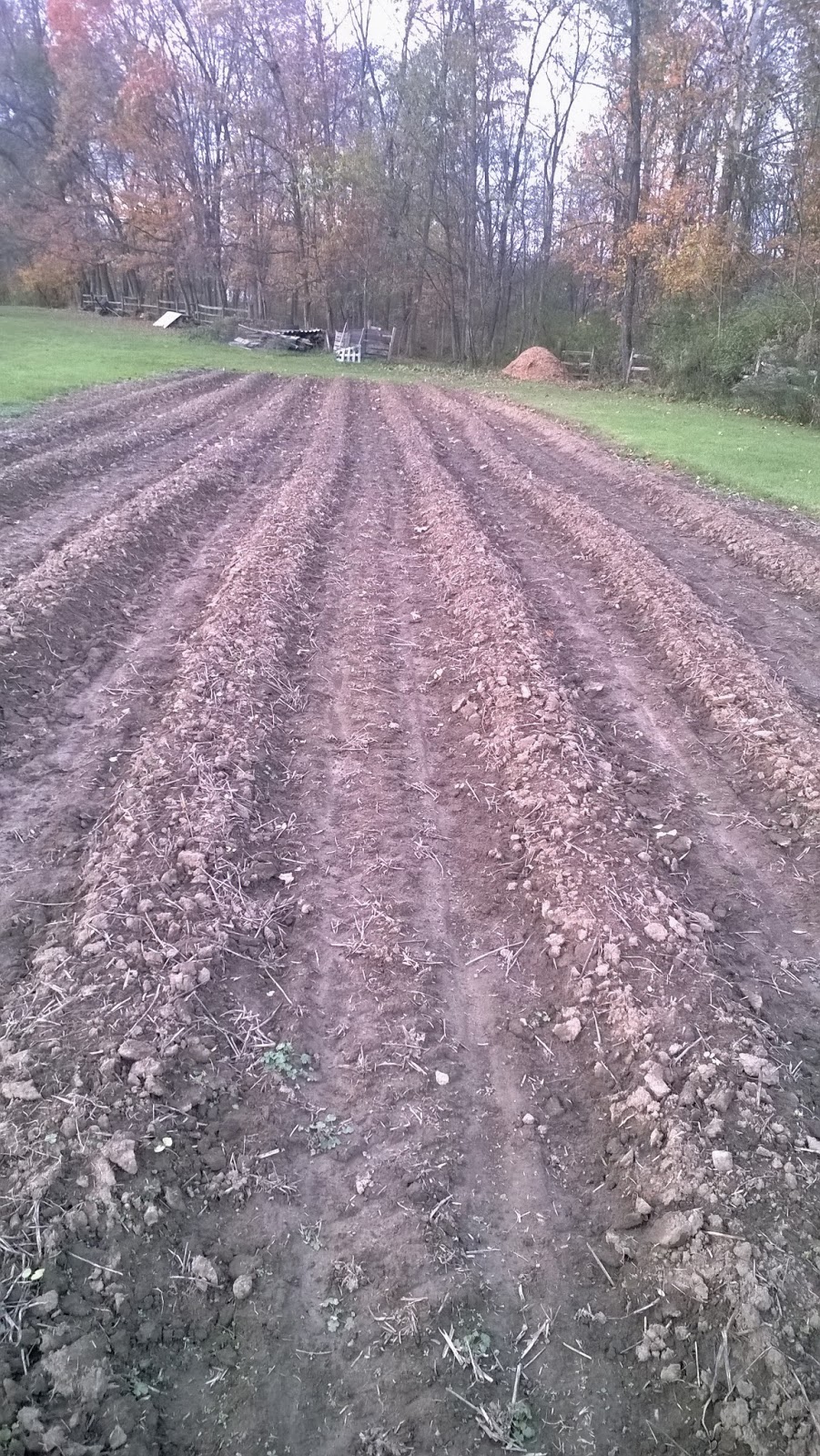 |
| Raised beds ready to plant garlic |
I think that wraps up what happened during the hiatus. We have lots of things planned for 2014 and my goal is to update this blog weekly with more tips, how-to's, and advice.
Stay tuned, it's going to be a great year.
Subscribe to:
Posts (Atom)